
US professional services firm: automating large-scale document classification with AI
Reshaping document-heavy workflows for a US professional services firm so AI did the sorting and the humans did the judging.
Context
A US professional services firm handling very high volumes of inbound structured and semi-structured documents. The classification step was manual, expensive, and the bottleneck that limited how quickly new client work could be onboarded.
Challenge
The firm had tested two off-the-shelf tools and seen uneven accuracy and poor integration with downstream workflows. Each false classification cost more in rework than the tool had saved. Confidence in "AI for classification" was low internally.
Approach
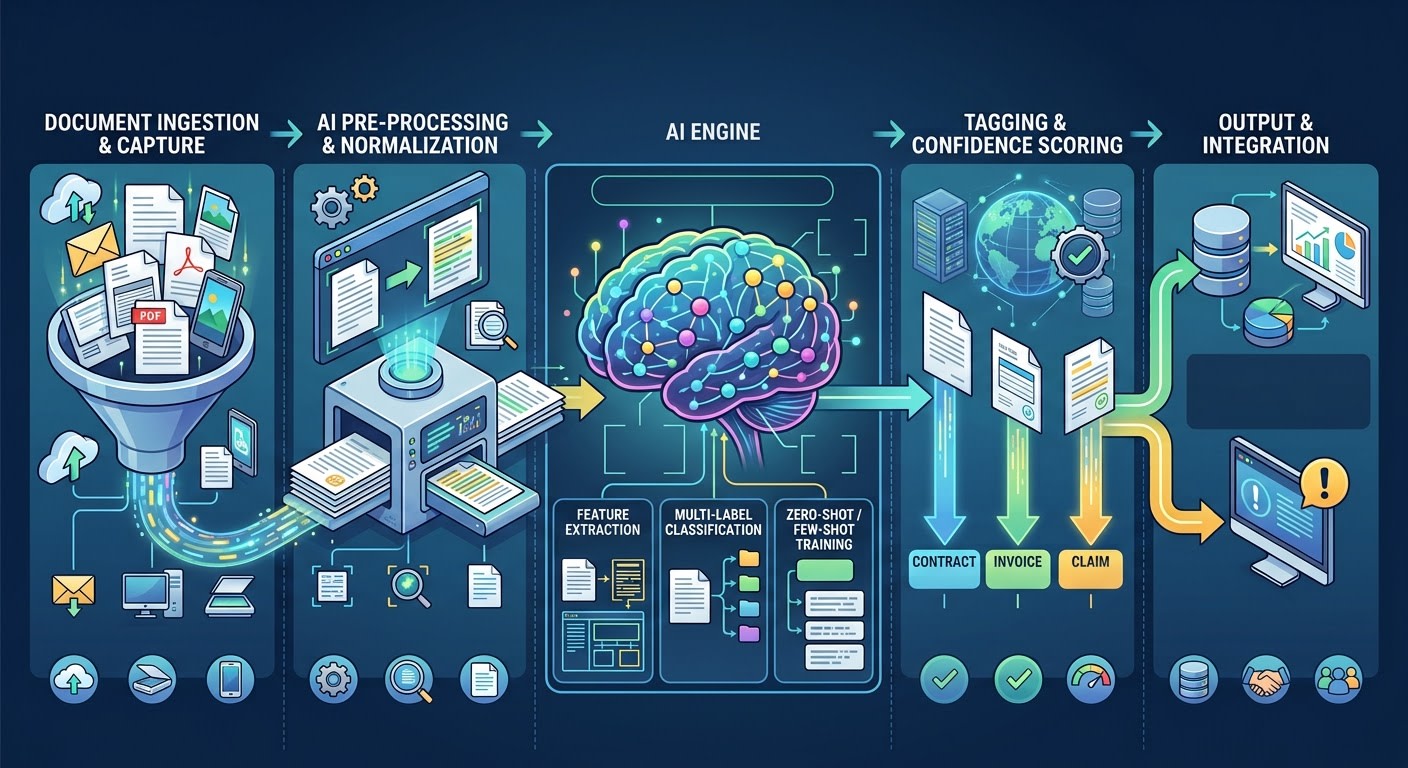
We treated the classifier as the easy half and the workflow redesign as the hard half. The model handled the bulk tier of documents with high confidence; a confidence-scored queue routed the edge cases to specialists; the specialists' corrections fed back into the training loop.
Equally important: we redesigned the measurement. The old KPI was classifications per hour. The new KPI was time from document arrival to decision-ready. That reframing made the organisation willing to let the model handle more of the easy tier.
What shifted
Onboarding throughput increased materially. More importantly, the specialists stopped spending their time on routine triage and started catching the pattern breaks that the system genuinely needed humans for.
What shifted: the humans moved up the value curve, not off it.
Client identity anonymised. Specific metrics available under NDA.